
Technical article · Part 1 of 3
Dipl.-Ing. David Mauro, Geospector Munich – article series “Stormwater retention facilities on federal highways”
This article series presents the stormwater retention facilities along Germany’s federal highways, how they work and the challenges involved in operating them. The facilities – often also called stormwater retention basins (RRB) – make an essential contribution to flood protection and prevent pollutants from entering the environment.
They are largely invisible to the public, even though they can be found in large numbers along highways and federal roads – roughly one every kilometer. The first part of this series explains their purpose and their basic functions.
Unlike precipitation on open land or water bodies, rain falling on compacted or sealed surfaces cannot simply seep away but has to be collected and drained in a controlled way. During thunderstorms and heavy rain in particular, however, such large volumes of water accumulate in a short time that they first have to be stored temporarily for flood protection. Only then are they slowly discharged into the sewer system or downstream water bodies so as not to flood them.
Cities as a whole are sealed surfaces, and the buffer facilities are usually built underground. The stormwater retention facility beneath the Hirschgarten park in Munich, for example, with a capacity of 90,000 m³, is one of the largest in Europe.
Roads are also sealed surfaces and must be treated accordingly, unless they are really narrow and drained, for example, by parallel infiltration ditches. One kilometer of highway (two lanes plus hard shoulder) corresponds to an area of around 2.5 hectares. In a typical heavy rainfall event of 20 liters per square meter per hour, which can occur several times a year, almost 8,000 liters of rainwater accumulate per minute. It goes without saying that without a buffer, these volumes of water would overload a sewer system or immediately flood receiving waters such as streams or smaller rivers – which is why retention facilities are necessary.
With road runoff, however, it must also be taken into account that it is usually contaminated with various pollutants that require further treatment of the water.
Apart from accidents, in which operating fluids such as oils and fuels can get directly onto the road, normal traffic alone is a major source of all kinds of pollutants. In addition to dust and fine particulates, a large share is accounted for by tire and road wear particles (TRWP), which are produced by direct abrasion between tires and the road surface, with the higher driving speeds on highways in particular contributing significantly. A large proportion of TRWP consists of microplastics, and road traffic is believed to be responsible for half of the microplastics released into the environment. Their toxicity has been the subject of numerous studies for some time.
Other sources of pollutants include brake dust. And even though asbestos was replaced by other materials long ago, chemical analyses reveal a number of substances, some of them highly toxic, that must not be allowed to enter the environment.
A pure retention function is therefore not sufficient for road runoff. It requires multi-stage stormwater treatment, which is usually structured according to the following scheme:
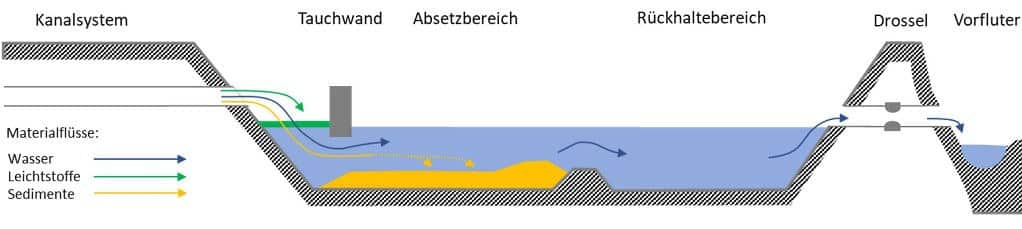
The original retention basin has thus evolved into a complex hydrological facility that can be implemented in a wide variety of ways.
The first facilities in Germany were built together with the trunk road network, especially the highways in the first half of the 20th century, and many of them are still in operation unchanged. Over time, requirements – above all for environmental protection – have increased, and a wide variety of designs have been tried out to find the optimum facility efficiency, also with regard to maintenance and operation. Only recently have there been efforts toward standardization, such as the “RiStWag” facilities in water protection areas designed by the German Road and Transportation Research Association (FGSV).
Germany thus has around 24,000 facilities, around 10,000 of them along highways alone (i.e. roughly one every kilometer), which come in different designs:
Operation requires extensive work to be carried out at regular intervals (e.g. annually) or after special events (e.g. heavy rain), for example:
The last point in particular is not trivial to solve and is examined in more detail in Part 2.
The facilities are generally dimensioned to provide an adequate settling and retention function even during unusually severe weather events. However, the continuous inflow of settleable solids leads to increasing silting of the bed, especially in the settling zone, which can impair the settling and retention function.
The operating regulations therefore require an inspection at least once a year. If sludge depths or volumes exceed specified limits, the facilities must be cleaned out.
Cleaning is usually laborious and costly, especially for facilities with a permanent pool: aquatic life often has to be “parked” elsewhere beforehand, and chemical analyses and approval procedures have to be carried out. Only then can the sludge, which is sometimes meters deep, be removed, e.g. by a floating dredger, dried and landfilled. Because the pollutants are often highly toxic, corresponding fees are charged by special landfills, so cleaning out a facility can easily cost more than EUR 100,000.
The elements referred to above as “pollutants” are therefore usually analyzed chemically before the sediment is removed in order to assess their toxicity. These substances are typically found in high concentrations, so disposal in special landfills is required: arsenic, lead, cadmium, chloride, cyanide, hydrocarbons, copper, mercury, sulfate, zinc.
In poorly maintained facilities, these substances enter the environment in two ways:
The consequences are the same in both cases: ongoing pollution of the surrounding environment and the downstream water cycle – possibly even reaching drinking water.
The risk of flooding of downstream water bodies by unbuffered surges is obvious. However, flooding can also occur within the facility itself, temporarily rendering important functional and safety equipment ineffective or even damaging it. The following example shows a baffle wall acting as a light liquid separator that was flooded after a heavy rainfall event, completely disabling its function. Pollutants such as oil, gasoline or diesel could enter the environment directly.
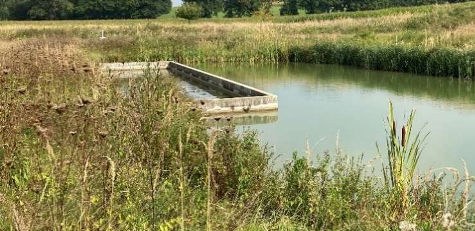
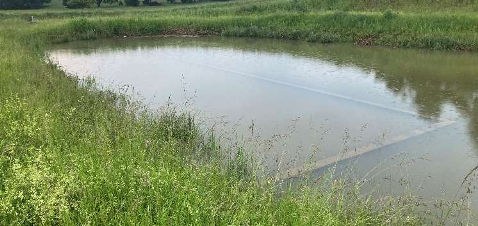
A clean facility, i.e. one without major sediment and sludge inflow, is therefore essential for safe operation, in order to prevent pollutants from entering the environment and to avoid flood risks. Appropriate measurements are therefore mandatory as part of routine maintenance. First of all, efficient ongoing monitoring of the criteria that trigger a clean-out is necessary. Subsequently, the inflow volumes must be determined precisely in order to obtain a reliable basis for planning, e.g. for tenders.
In practice, however, reliably measuring the inflow quantities often runs into major problems and is unexpectedly laborious. This applies above all to facilities with a permanent pool, of which there are 6,000–7,000 along German highways alone.
Part 2 explains the measurement challenges in more detail and presents possible solutions.
With the Geospector Sludge Check, we survey the sediment surface and bed of your stormwater retention facilities area-wide by drone – without a boat and without the need for an existing baseline survey.
The full article is also available as a PDF download (in German).

